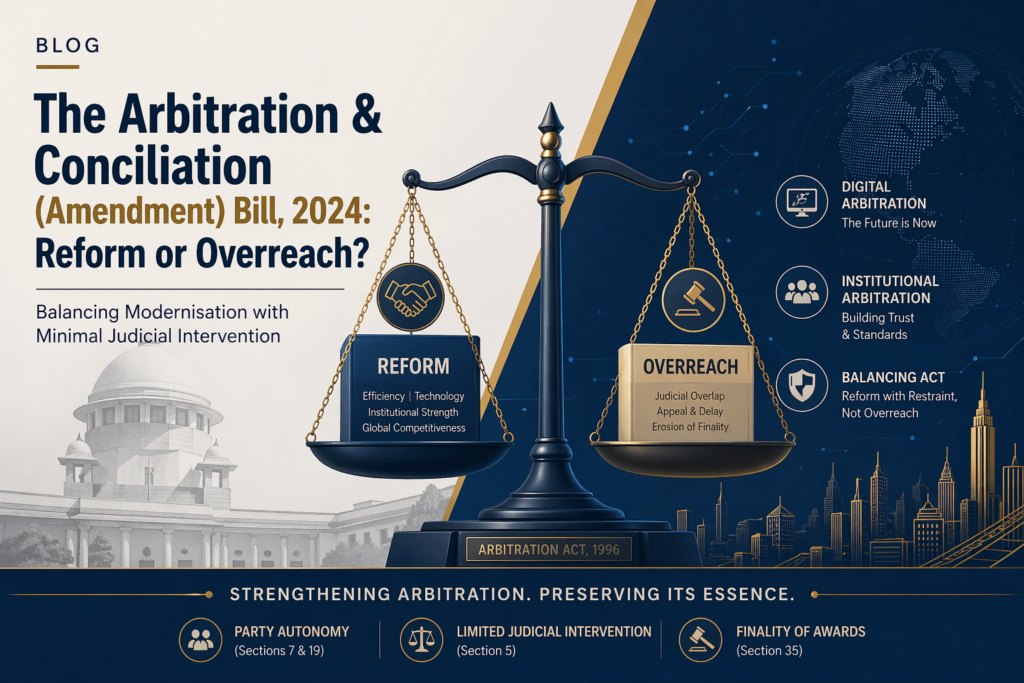
The Draft Arbitration and Conciliation (Amendment) Bill, 2024, introduced by the Government of India in October 2024, represents the latest step in India’s continuing effort to position itself as a global arbitration hub. Building upon earlier amendments of the arbitration and conciliation act in 2015, 2019, and 2021, the Bill seeks to modernize the arbitration framework by strengthening institutional arbitration, embracing technological advancements, and improving procedural efficiency.
However, while the intent appears reformative, several provisions have raised concerns within the legal community, leading to an important question: does the Bill truly advance arbitration in India, or does it risk introducing regulatory overreach that could undermine its core principles?
Reformative Intent: Strengthening the Framework
At its core, the 2024 Draft Bill reflects a clear policy direction which is moving India away from ad hoc arbitration toward a more structured, institutional model.
- Recognition of Emergency Arbitration
One of the key features of the Bill is the formal recognition of emergency arbitration. While the current framework under Section 9 of the Arbitration and Conciliation Act, 1996 allows parties to approach courts for interim relief, and Section 17 empowers arbitral tribunals to grant interim measures, the Bill seeks to bridge the gap by recognising emergency arbitrators within the statutory framework. This aligns Indian arbitration law with international practices.
2. Digitalisation of Arbitration Proceedings
The Bill also introduces provisions enabling digital arbitration proceedings, including electronic filings, virtual hearings, and digital awards. These changes supplement the existing framework under Section 19, which allows arbitral tribunals flexibility in procedure, and aim to bring greater efficiency and accessibility to arbitration.
3. Promotion of Institutional Arbitration
The Bill continues the policy direction introduced through Section 11(3A) (as amended), which promotes institutional appointment of arbitrators. By strengthening institutional mechanisms, the Bill seeks to reduce delays and enhance consistency in arbitral proceedings.
The Arbitration Council of India: A Missing Piece
A central aspect of the proposed framework is the Arbitration Council of India (ACI), introduced under Sections 43B to 43M of the Act. The ACI is envisaged as a body responsible for grading arbitral institutions, accrediting arbitrators, and promoting standards.
However, despite its statutory recognition, the ACI has not been fully constituted or made operational. This creates a regulatory vacuum where a body central to the success of institutional arbitration remains largely non-functional.
Without an effective ACI, the implementation of institutional arbitration reforms remains incomplete, raising concerns about the practical impact of the Bill.
Concerns of Overreach: Expanding Judicial Intervention
While the Bill introduces progressive elements, it also raises concerns regarding increased judicial oversight.
- Expansion of “Patent Illegality”
Under the current framework, Section 34(2A) permits courts to set aside domestic arbitral awards on the ground of “patent illegality.” This ground is deliberately excluded from international commercial arbitration to preserve finality.
The proposed expansion of this ground to international commercial arbitration risks blurring this distinction and may lead to increased challenges to awards, thereby diluting the principle of minimal judicial interference under Section 5 of the Act.
- Additional Layers of Review
The Bill has also been criticised for potentially introducing additional appellate mechanisms. At present, Section 37 provides limited grounds for appeal in arbitration matters. Expanding this framework could increase litigation and delay enforcement, contrary to the objective of speedy dispute resolution.
- Remand of Awards
The possibility of remanding arbitral awards back to tribunals for reconsideration raises further concerns. While this may be intended to reduce setting aside of awards, it risks prolonging proceedings and undermining finality.
These developments highlight a key tension: arbitration is designed to minimise court interference, yet increased oversight risks converting it into a litigation-heavy process.
Reform vs Overreach: Finding the Balance
The 2024 Draft Bill reflects a broader shift from minimal regulation toward structured oversight. While this is necessary to build credibility and institutional strength, it must not come at the cost of arbitration’s foundational principles.
India’s arbitration framework must continue to uphold:
- Party autonomy (Sections 7 and 19)
- Limited judicial intervention (Section 5)
- Finality of awards (Section 35)
At the same time, reforms must address practical challenges such as delays, lack of institutional capacity, and procedural inefficiencies.
The key lies in striking a balance ensuring that regulatory mechanisms enhance arbitration rather than constrain it.
Conclusion
The Arbitration & Conciliation (Amendment) Bill, 2024, is neither purely reformative nor entirely excessive, it is a blend of both.
It takes meaningful steps toward modernizing India’s arbitration and conciliation act, particularly through the recognition of emergency arbitration and digital processes. However, certain provisions risk expanding judicial oversight and introducing procedural complexity.
As the Bill undergoes public consultation, it presents an opportunity to refine its provisions. The goal should not merely be to regulate arbitration, but to strengthen it as a credible, efficient, and globally competitive dispute resolution mechanism.
Ultimately, the question is not whether India needs reform in arbitration,it does.
The real question is whether that reform can be achieved without compromising the principles that make arbitration effective.